
Mechanical systems are composed of components that work together to transmit power, motion, and force. Understanding these basic components is crucial for anyone studying mechanical engineering or working in industries like manufacturing, automotive, and robotics. This blog focuses on five fundamental elements: gears, shafts, bearings, couplings, and keys.
1. Gears
Gears are mechanical components with teeth that mesh with the teeth of another gear to transmit torque and rotational motion. They are widely used in machinery to increase or decrease speed, change direction, or amplify torque.
Types of Gears
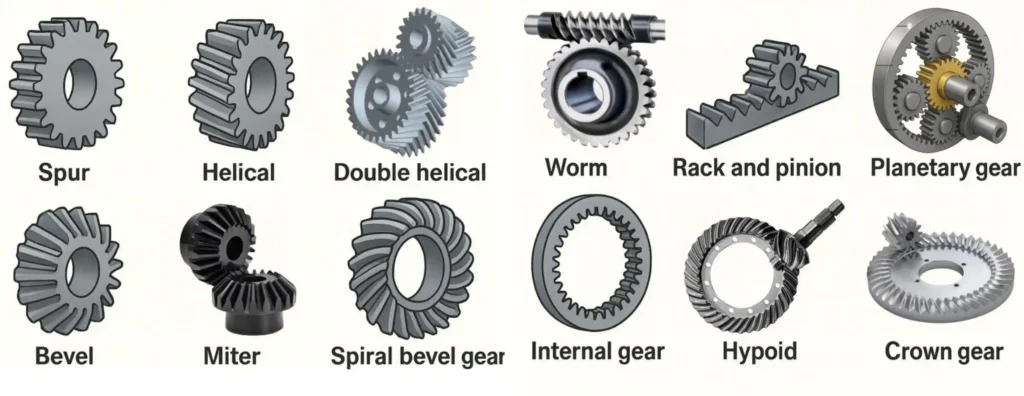
| GEAR | DESIGN | USAGE |
| 1. Spur Gear | Straight teeth, parallel to the shaft. | Watches, printers, simple gearboxes, and machine tools. |
| 2. Helical Gear | Teeth cut at an angle (helix angle); smooth and quiet operation. | Car transmissions, conveyors, high-speed machines. |
| 3. Double Helical Gear (Herringbone Gear) | Two helical gears in a “V” shape; no axial thrust. | Heavy machinery, ship drives, compressors. |
| 4. Bevel Gear | Conical shape, used when shafts meet at 90° or other angles. | Hand drills, differential, marine drives. |
| 5. Miter Gear | A special bevel gear pair with a 1:1 ratio (same number of teeth). | Direction change at 90° without changing speed. |
| 6. Spiral Bevel Gear | Bevel gear with curved/spiral teeth, smooth and high load capacity. | Automotive differentials, aerospace drives, high-speed shafts. |
| 7. Worm Gear | Screw-like worm + worm wheel; very high reduction ratios. | Hoists, elevators, conveyors, tuning devices, gate openers. |
| 8. Rack and Pinion | Straight rack + round pinion; converts rotary motion to linear. | Car steering, CNC machines, and sliding gates. |
| 9. Planetary Gear (Epicyclic Gear) | Sun gear in the center, planet gears around it, ring gear outside. | Automatic car transmissions, robotics, wind turbines. |
| 10. Internal Gear | Teeth cut inside the gear; used with an external gear inside it. | Planetary gear systems, compact drives, hydraulic pumps. |
| 11. Hypoid Gear | Similar to spiral bevel, but the shafts are offset; smooth and high torque. | Rear axle differential in cars & heavy-load drives. |
| 12. Crown Gear | Teeth cut at right angles on the face of the gear (like a crown). | Low-speed mechanisms, positioning systems, and old mechanical toys. |
Functions of Gears
- Amplify torque
- Transmit motion from one shaft to another
- Increase or decrease rotational speed
- Change the direction of motion
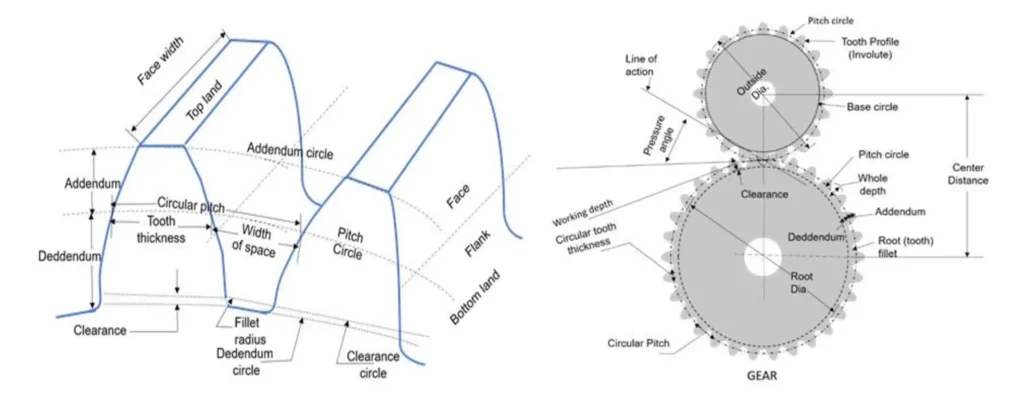
2. Shafts
A shaft is a rotating component that transmits power from one part of a machine to another. Shafts are generally cylindrical and made of strong materials such as steel to withstand torque and bending forces.
Types of Shafts
Various shafts used in machines and automotive applications are mentioned below, categorized by their function and design.
a) Transmission Shafts
b) Machine Shafts
c) Axle shaft
d) Special Purpose Shafts
Functions of Shafts
- Transfer rotational motion and torque
- Support rotating parts like gears, pulleys, and bearings
- Maintain alignment of mechanical components
Example-
- Shafts in turbines transmit energy from blades to generators.
- The crankshaft in an engine converts the pistons’ reciprocating motion into rotational motion.
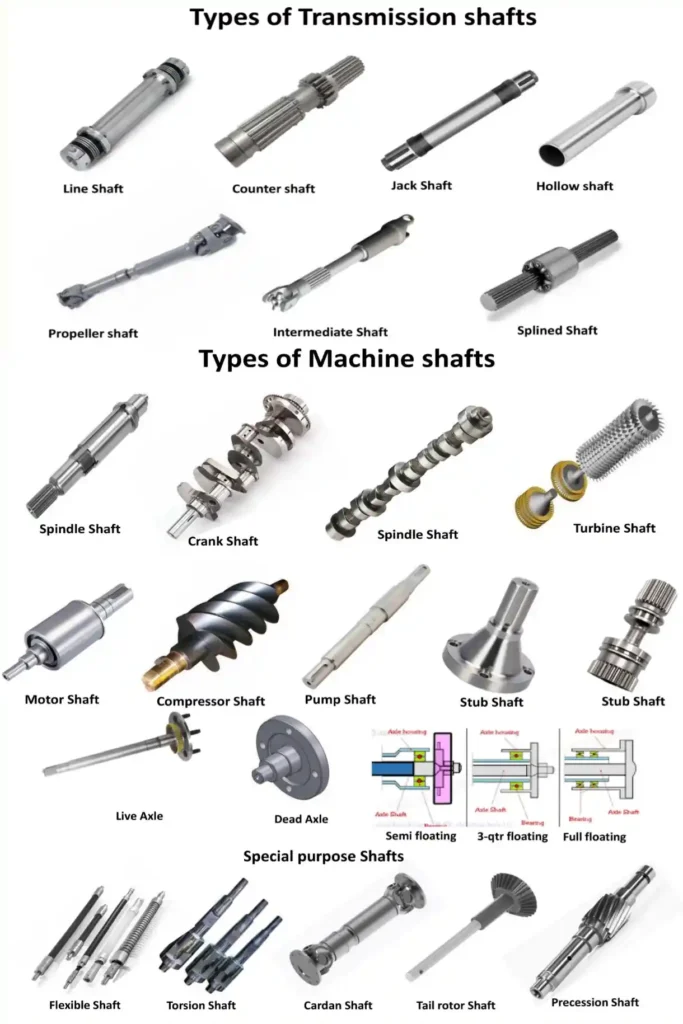
a) Transmission Shafts
Used to transmit power from one machine/section to another.
- Line Shaft: A long shaft for power distribution via belts/pulleys.
- Counter Shaft: Secondary shaft carrying gears to change speed.
- Jack Shaft: Intermediate shaft connecting the main shaft to the machine unit.
- Propeller/Drive Shaft: Hollow shaft with universal joints; connects gearbox to differential.
- Intermediate Shaft: Connects the engine, gearbox, and final drive.
- Splined Shaft: Shaft with ridges (splines) to prevent slipping.
- Hollow Shaft: Lighter but strong; used in high-speed drives.
b) Machine Shafts
These are integral parts of a machine.
- Spindle Shaft: Short, precise, high-stiffness shaft (lathe/mill/CNC).
- Crankshaft: Converts reciprocating motion to rotary motion for engines.
- Camshaft: Opens/closes valves using cams (engines).
- Turbine Shaft: Long shaft connecting the turbine to the generator.
- Motor Shaft: The Main rotating shaft of electric motors.
- Compressor Shaft: High-speed balanced shaft for impellers.
- Pump Shaft: Connects motor to pump impeller.
- Stub Shaft: Short shaft on gearbox/motor ends.
- Quill Shaft: Hollow, thin shaft that fits over another shaft.
c) Axle shaft
Support wheels may or may not rotate.
- Live Axle: Rotates and delivers power to wheels.
- Dead Axle: Does not rotate; wheels rotate around it.
- Semi-Floating Axle: Supports weight + transmits torque.
- Full-Floating Axle: Transmits torque only; wheel load on housing.
- Three-Quarter Floating Axle: Medium-load axle; partially load-bearing.
d) Special Purpose Shafts
For specific mechanical requirements.
- Flexible Shaft: Cable-like, bends while transmitting motion.
- Torsion Shaft: Designed to twist and absorb shock (torsion bars).
- Cardan Shaft: a Long shaft with universal joints for misalignment.
- Tail Rotor Shaft: a High-speed shaft for a helicopter.
- Precision Shaft: a highly balanced shaft for turbines and aerospace.
Functions of Shafts
- Transfer rotational motion and torque
- Support rotating parts like gears, pulleys, and bearings
- Maintain alignment of mechanical components
Example-
- The crankshaft in an engine converts the pistons’ reciprocating motion into rotational motion.
- Shafts in turbines transmit energy from blades to generators.
3. Bearings
Bearings are mechanical elements that support rotating shafts and reduce friction between moving parts. They allow smooth motion, improve efficiency, and increase the lifespan of machinery.
Types of Bearings
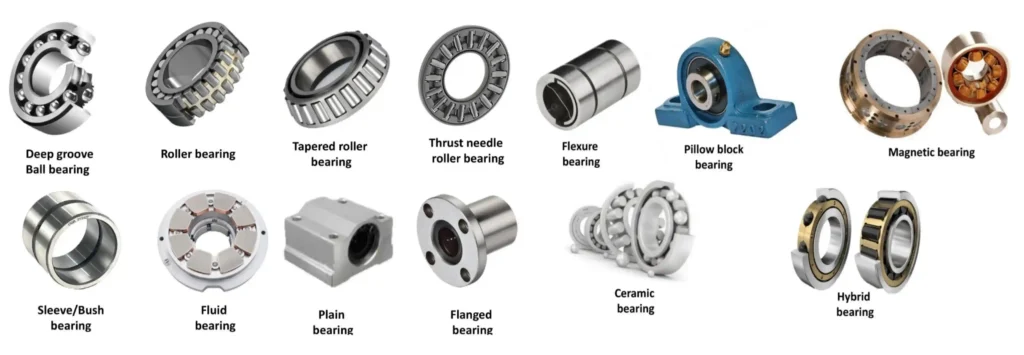
a) Rolling Contact Bearings (Anti-Friction Bearings)
Use rolling elements – lower friction, high speeds.
(I) Ball Bearings
- Deep Groove Ball Bearing: Most common; handles radial + small axial loads.
- Angular Contact Ball Bearing: Handles high axial loads in one direction; used in pumps & machine spindles.
- Self-Aligning Ball Bearing: Accommodates shaft misalignment; used in long shafts.
- Thrust Ball Bearing: For axial loads only; used in turntables, vertical shafts.
(II) Roller Bearings
- Cylindrical Roller Bearing: High radial load; used in gearboxes, electric motors.
- Needle Roller Bearing: Tiny diameter rollers; compact; used in automotive transmissions.
- Tapered Roller Bearing: Handles combined radial + large axial load; used in wheels, axles.
- Spherical Roller Bearing: Self-aligning + high load capacity; used in heavy machinery.
- Thrust Roller Bearing: For large axial loads; used in cranes, heavy presses.
B) Plain Bearings (Sleeve/Bush Bearings)
No rolling elements – sliding motion – high damping & simple.
- Journal Bearing: Supports radial load; shaft rotates in a sleeve (bushing).
- Thrust Bearing (Plain): Supports axial load; collar slides on thrust pad.
- Sleeve / Bush Bearing: Simple cylindrical sleeve; used in pumps & fans.
- Flanged Bearing: Sleeve with flange for easy mounting; used in conveyors.
- Tilting Pad Bearing: Pads tilt to form an oil film; used in turbines & compressors.
C) Fluid Film Bearings
Load supported by fluid film – no metal contact.
- Hydrodynamic Bearing: Fluid film generated by rotation; used in turbines, marine shafts.
- Hydrostatic Bearing: External pump supplies fluid; very stable; used in precision machines.
- Squeeze Film Bearing: Film formed by oscillation; used in vibration dampers.
D) Magnetic Bearings
Support shaft using magnetic force – frictionless, high speed.
- Active Magnetic Bearing (AMB): Electromagnets + control system; used in high-speed compressors.
- Passive Magnetic Bearing: Permanent magnets; no control system; lower precision.
E) Flexure Bearings
Load supported by bending elastic elements; no friction.
- Leaf Flexure: Thin metal strip; used in instruments.
- Notch Flexure: Precision motion stages.
F) Other Special Bearings
- Linear Bearings: Provide straight-line motion; used in CNC & robotics. (It might be Ball guide type, Roller guide type, LM guideways & Bush-type)
- Pillow Block / Plummer Block Bearings: Housing + bearing for easy mounting on frames.
- Mounted Bearing Units: Ball bearings in a cast housing – easy replacement.
- Ceramic Bearings: Use ceramic balls for high-speed, corrosion-resistant applications.
- Hybrid Bearings: Steel rings + ceramic balls; used in electric motors.
Functions of Bearings
- Reduce friction between moving parts
- Support shafts and rotating components
- Allow smooth and precise motion
- Absorb and distribute loads
Example-
- Bearings in electric motors allow shafts to rotate smoothly.
- Automobile wheel bearings enable wheels to rotate freely with minimal friction.
4. Couplings
Couplings are devices used to connect two shafts at their ends for transmitting power. They are designed to accommodate misalignment, absorb shock loads, and reduce vibration.
Types of Couplings
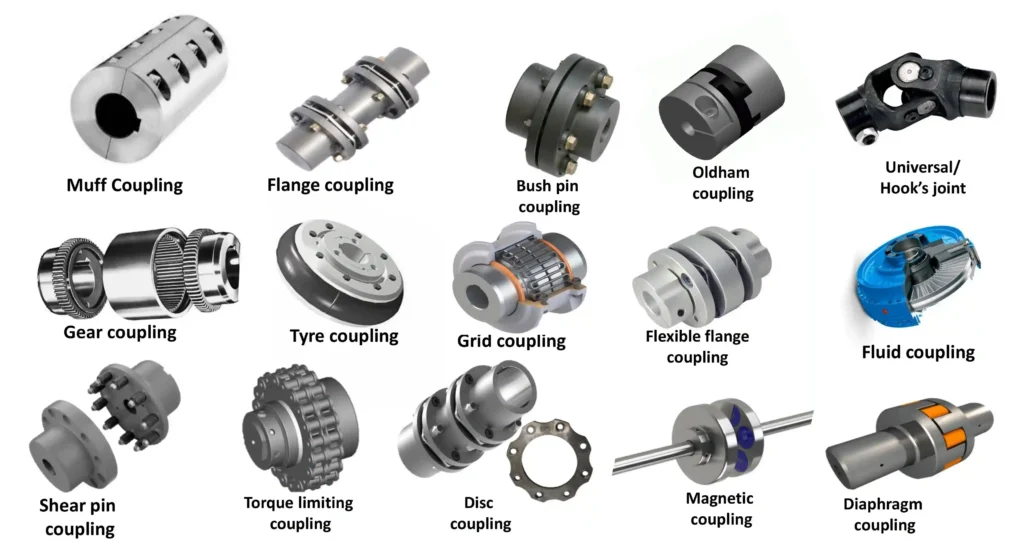
a) Rigid Couplings
Used when shafts must be joined perfectly aligned. No flexibility.
- Sleeve (Muff) Coupling: Hollow cylindrical sleeve fits over both shaft ends & is keyed & used in Simple pumps, and conveyors.
- Clamp (Split Muff / Compression) Coupling: Two split halves bolted together around the shaft. Easy to assemble/disassemble without moving shafts.
- Flange Coupling: Two flanges keyed to the shaft and bolted together. Use: Heavy loads, industrial drives, marine shafts.
b) Flexible Couplings
Allow misalignment, shock absorption, and vibration damping.
- Bush Pin Coupling: Pins with rubber bushes between flanges.Dampens vibration in compressors, blowers, and pumps.
- Oldham Coupling: Three plates-middle disc slides in slots.High misalignment capacity in light machinery & robotics.
- Universal (Hooke’s) Joint: Cross-shaped spider between two yokes.Cars, and power transmission at changing angles.
- Gear Coupling: Flanges with external teeth + sleeve with internal teeth. Very high torque – steel mills, rolling mills.
- Tyre Coupling: A Flexible rubber tyre between two hubs. High flexibility, good for misalignment & shock loads.
- Grid Coupling: Spring-steel grid fits between grooved hubs, providing smooth shock absorption in heavy-duty motors.
- Flexible Flange Coupling: Similar to flange coupling but uses a rubber/flexible element. Medium-duty machinery where slight misalignment exists.
c) Fluid Coupling
Hydraulic / Fluid Coupling: Uses oil circulation between the pump and the turbine: Smooth start, overload protection—conveyors, crushers.
d) Safety / Limited Torque Couplings
- Shear Pin Coupling: The pin breaks during overload to protect machinery. Conveyors, agricultural equipment.
- Torque Limiting Coupling: Uses a spring-loaded mechanism that slips during overload.High-value machines that need protection from jamming.
e) Specialized Couplings
- Flexible Disc Coupling: Thin stainless-steel discs transmit torque for High-speed applications (pumps, turbines).
- Magnetic Coupling: Magnets transfer torque without physical contact. Leak-proof pumps handling chemicals.
- Diaphragm Coupling: A Flexible metal diaphragm transmits torque – ideal for high-speed turbomachinery.
Functions of Couplings
- Transmit torque between two shafts
- Compensate for misalignment
- Reduce vibration and shock
- Protect machinery from overload
Example-
- Flexible couplings in pumps and compressors reduce misalignment issues.
- Gear couplings in heavy-duty machinery transmit high torque efficiently.
5. keys(Shaft keys)
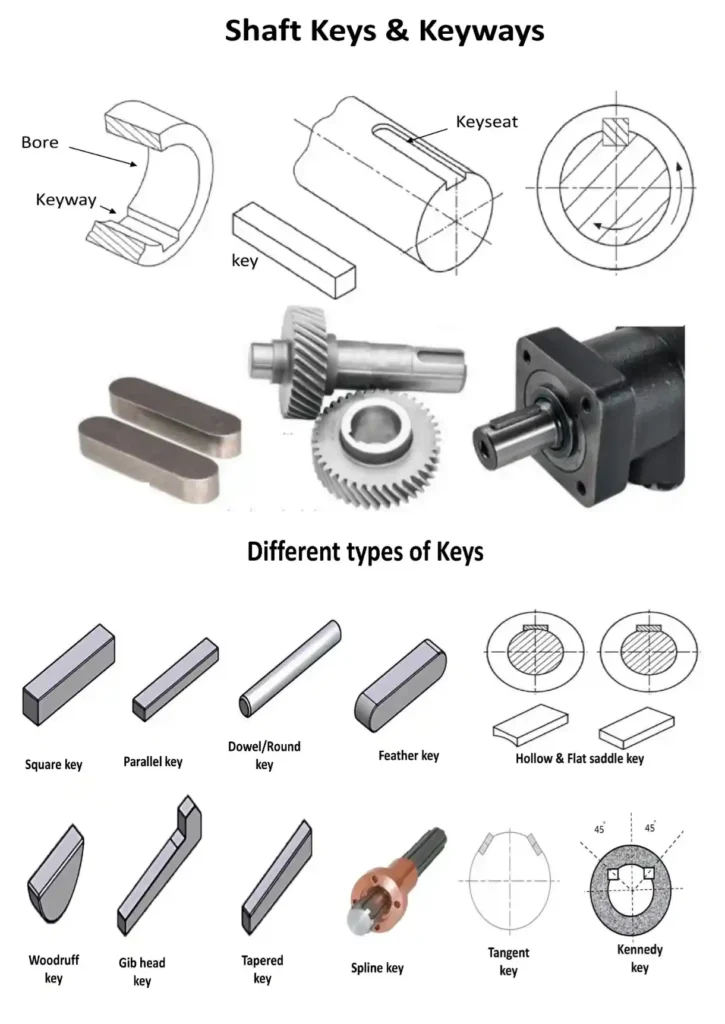
A Key is used in a shaft keyway to retain mechanical power-transmission components, such as gear drives and pulleys, to transmit power.
Types of Keys
1. Sunk Keys
Keys partly sunk into the shaft and hub.
- Square Key: Most common key; square cross-section; good for general torque transmission.
- Rectangular Key: Stronger in shear; used where space is limited axially.
- Parallel Key: Uniform width & thickness; used when the shaft and hub need accurate alignment.
- Gib-Head Key: Rectangular key with a head for easy removal.
- Feather Key: Allows sliding motion between shaft and hub; used in sliding gears/clutches.
- Woodruff Key: Semi-circular; fits in curved seat; prevents key rolling; used in machine tools/automobiles.
2. Saddle Keys
Key fits on the shaft surface (not sunk), suitable for light loads.
- Flat Saddle Key: Flat bottom; relies on friction; for low-power transmission.
- Hollow Saddle Key: Curved bottom matching shaft; slightly better fit than flat type.
3. Tangent Keys
Two tapered keys placed at 90°; transmit heavy torque in one direction; used in large shafts.
4. Round / Pin Keys
Cylindrical; used as dowel pins for location and light torque; simple to manufacture. (pin dia=Shaft dia/6)
5. Splines (Multiple Keys)
Multiple keyways along the shaft; used where high torque and accurate alignment are needed (automobiles, gearboxes).
- Straight Spline: Parallel grooves; common in sliding members.
- Involute Spline: Gear-like teeth; high strength and accurate torque transmission.
- Serrated Spline: Triangular tooth form; used in small-diameter shafts.
6. Kennedy Key (Pair of Keys)
Two square keys placed at 90°, used for heavy-duty
Basic Formulas
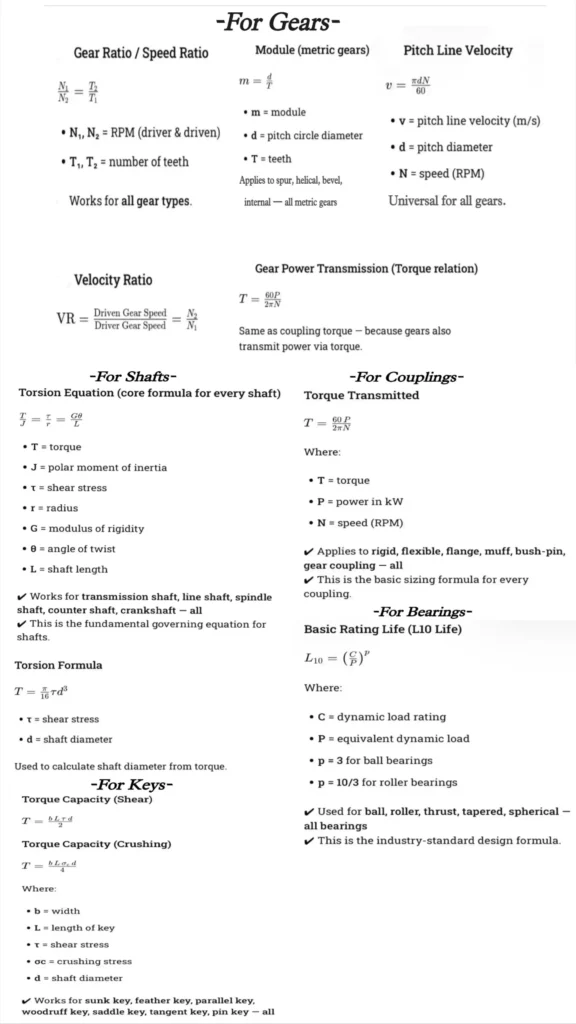
Understanding basic mechanical components like gears, shafts, bearings, couplings, and keys is fundamental for designing and maintaining efficient machinery. Each element has a specific function, and its proper selection ensures smooth operation, reliability, and longevity of mechanical systems.
Whether you are a student learning the basics or an engineer working on practical applications, mastering these components is the first step toward advanced mechanical engineering concepts.
Read about how to make cybersecurity a career option