
Electricity directly affects daily life, from switching on a light to running factories. Every electrical device works because of fundamental electrical laws and principles. Understanding these laws helps in safe usage, correct load calculation, appliance selection, and fault prevention.
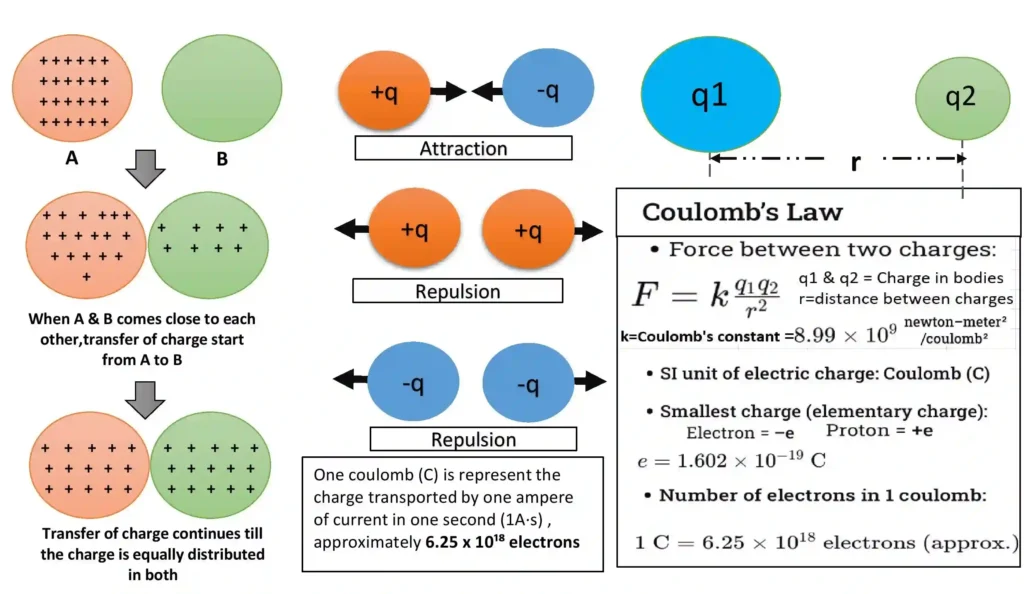
1. Law of Conservation of Electric Charge
- Electric charge can neither be created nor destroyed; it can only be transferred from one body to another.
- Total charge in an isolated system always remains constant.
- Electric exist in discrete packets .
- Charge q = ne , (n = no. of electrons)
- Applications
- Battery charging : Charge is transferred from charger to battery cells.
- Capacitors : Charge stored on plates is conserved.
- Static electricity : Rubbing a balloon transfers charge, not creates it.
2. Electric Potential Difference (Voltage Principle)
- Electric potential difference is the work done per unit charge to move a charge between two points.
- electric potential = work done/charge = v = w/q (in volt)
- Current flows from higher potential to lower potential in a closed circuit.
- 12 v battery means each coulomb of charge has 12 joules of energy.
- Applications
- Household supply (230 V): Provides enough force to run appliances.
- Mobile charger (5–12 V): Low voltage ensures safety for small devices.
- Electric shock severity: Higher voltage increases danger.
3. Electric Current Principle
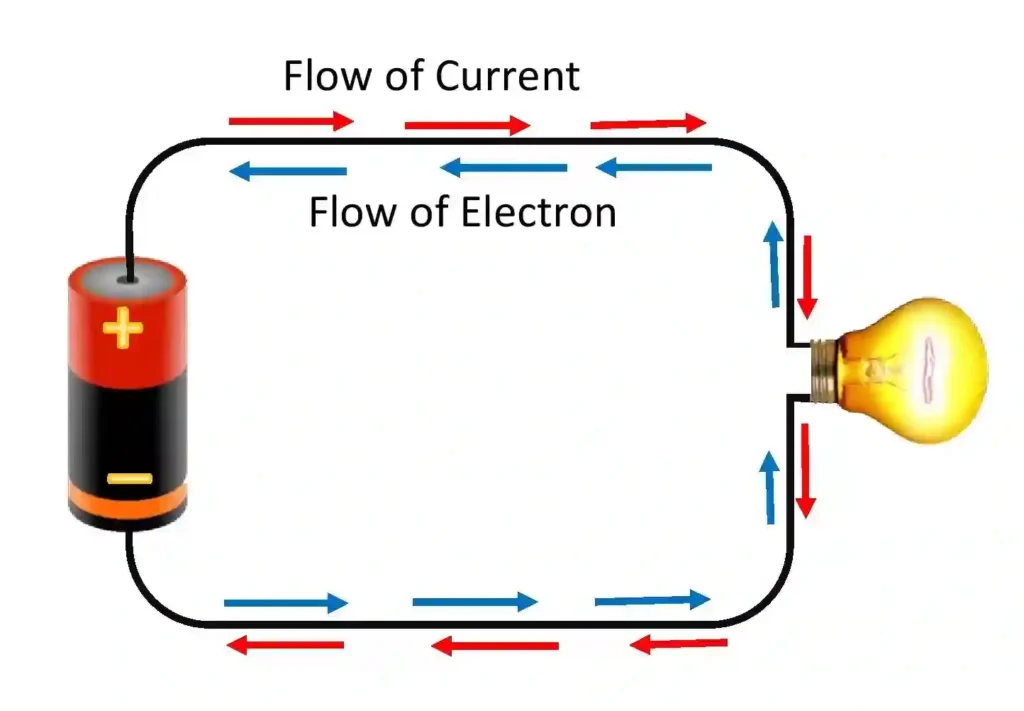
- Electric current is the rate of flow of electric charge.
- electric current flows only in a close circuit.
- Current is caused by movement of free electrons in conductors.
- 1 ampere(a) current equals to 1 coulomb charge flowing in 1 second.
- i = q / time
- Applications
- Heaters: High current produces more heat.
- Mobile phones: Low current for delicate circuits.
- Wire heating: Excess current overheats wires.
4. Resistance Principle
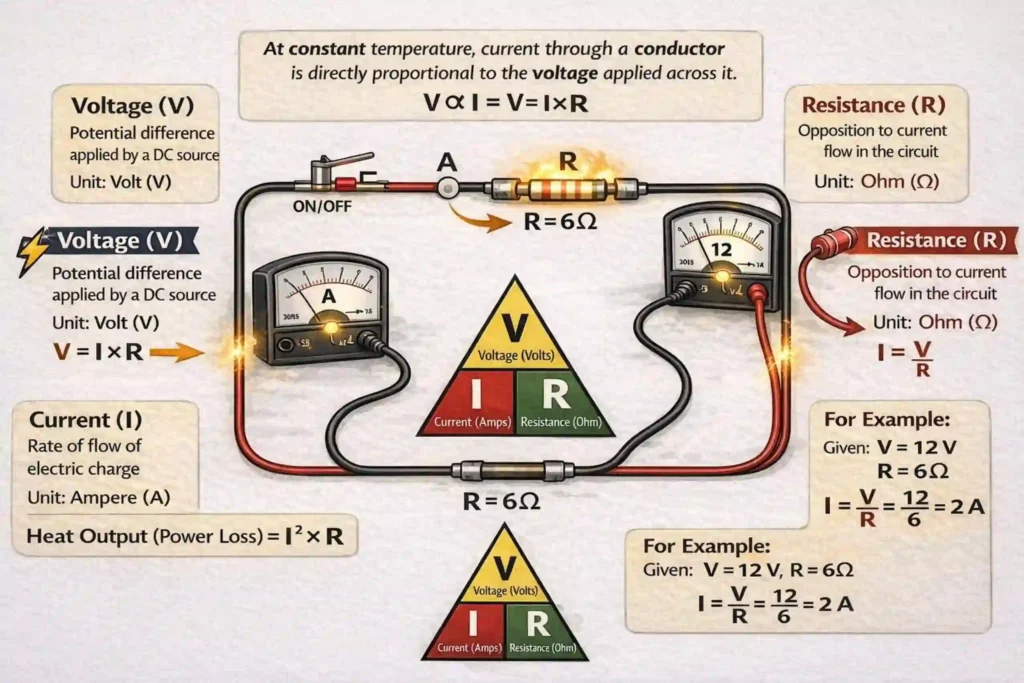
- Resistance is the opposition offered by a conductor to the flow of electric current.
- Resistance is further explained & analyzed through ohm’s law.
- Applications
- Heating elements: High resistance produces heat.
- Copper wiring: Low resistance reduces power loss.
- Long extension cords: Higher resistance causes voltage drop.
5. Ohm’s Law
- At constant temperature, current through a conductor is directly proportional to voltage and inversely proportional to resistance.
- v = i.R , I = V/R , R = V/I
- resistance increase with length of conductor & decrease with the cross section area of conductor.
- r=⍴ l/a , ⍴=Special resistivity
- conductors resistance increase with temperature increase.
- semiconductors resistance decrease with temperature increase.
- Applications
- Selecting correct wire size
- Calculating current before installing appliances
- Designing electrical circuits safely
6. Electrical Power Law
- Electrical power is the rate at which electrical energy is consumed.
- Basic Electric Power Formula in AC & DC Circuits
- Power in DC Circuits
- P = V x I = I2 x R = V2 / R
- Power in Single Phase AC Circuits
- P = V x I x Cos Ф = I2 x R x Cos Ф = V2 / R (Cos Ф)
- Power in Three Phase AC Circuits
- P = √3 x VL x IL x Cos Ф = 3 x VPh x IPh x Cos Ф = 3 x I2 x R x Cos Ф = 3 (V2 / R) x Cos Ф
- P = Power in Watts , V = Voltage in Volts , i = Current in Amperes
VPh x IPh = phase voltage & current , VL , IL = Line voltage & current , R= resistance in Ohms (Ω)
Cos Ф = Power Factor
- Applications
- Electricity bills (Watt rating)
- Appliance selection (AC, geyser, heater)
- Generator sizing
7. Electrical Energy Law
- Electrical energy is the total power consumed over a period of time.
- Electricity consumed , e = p t = v i= I2 R T
- p=power consumed ,t= time of power supply
- for example, 1 kW heater will consume power for 5 hours
- 1 kW× 5 hours = 5 kwh = 5 units
- Applications
- Electricity billing (kWh units)
- Estimating monthly energy consumption
8. Joule’s Law of Heating
- Heat produced is proportional to square of current, resistance, and time.
- produced heat , q = I2 R T
- the heat energy produced in resistance of 5 Ω when 3 A current flows through it for 2 minutes is
Q = I2 R T
Q = 32× 5 × (2 × 60) = 5400 Joule - Applications:
- Electric iron & heater
- Fuse melting during overload
- Overheating of undersized wires
9. Kirchhoff’s Current & Voltage Law
Kirchhoff’s Current Law
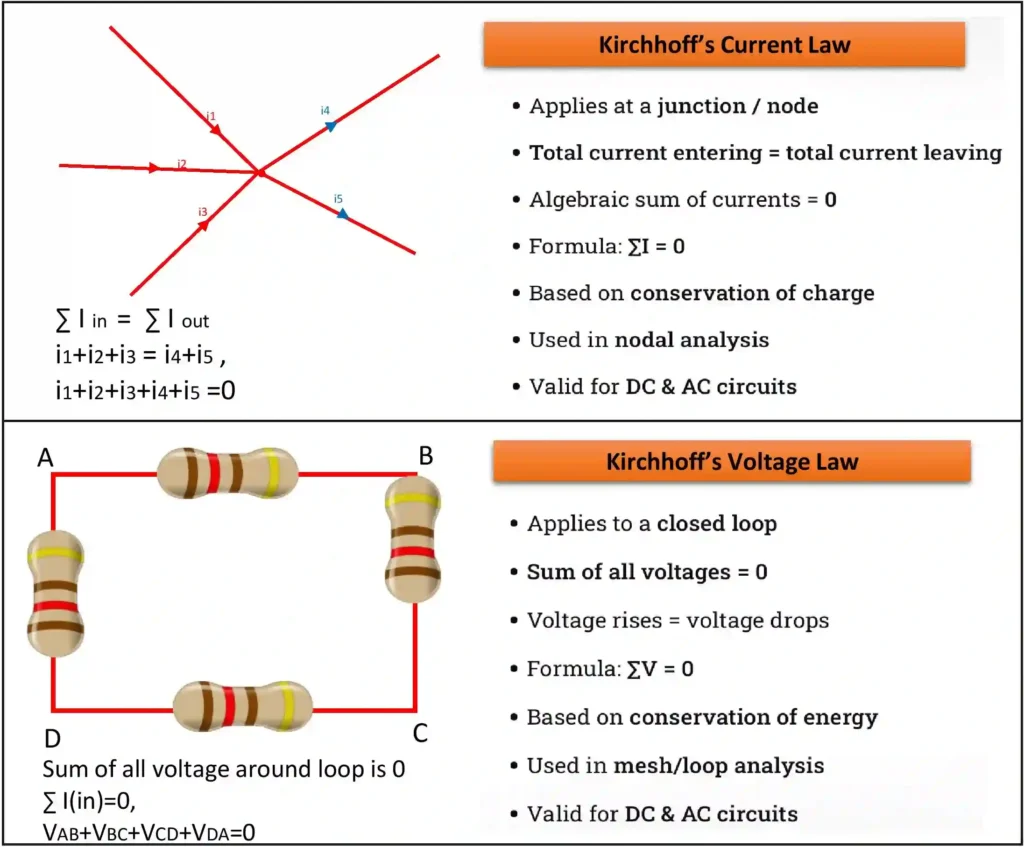
- The algebraic sum of currents at a junction is zero.
- Applications
- Distribution boards
- Parallel household wiring
- Electronic circuit design
Kirchhoff’s Voltage Law
- The algebraic sum of voltages in a closed loop is zero.
- Applications
- Battery charging circuits
- Inverter and UPS design
- Automotive electrical systems
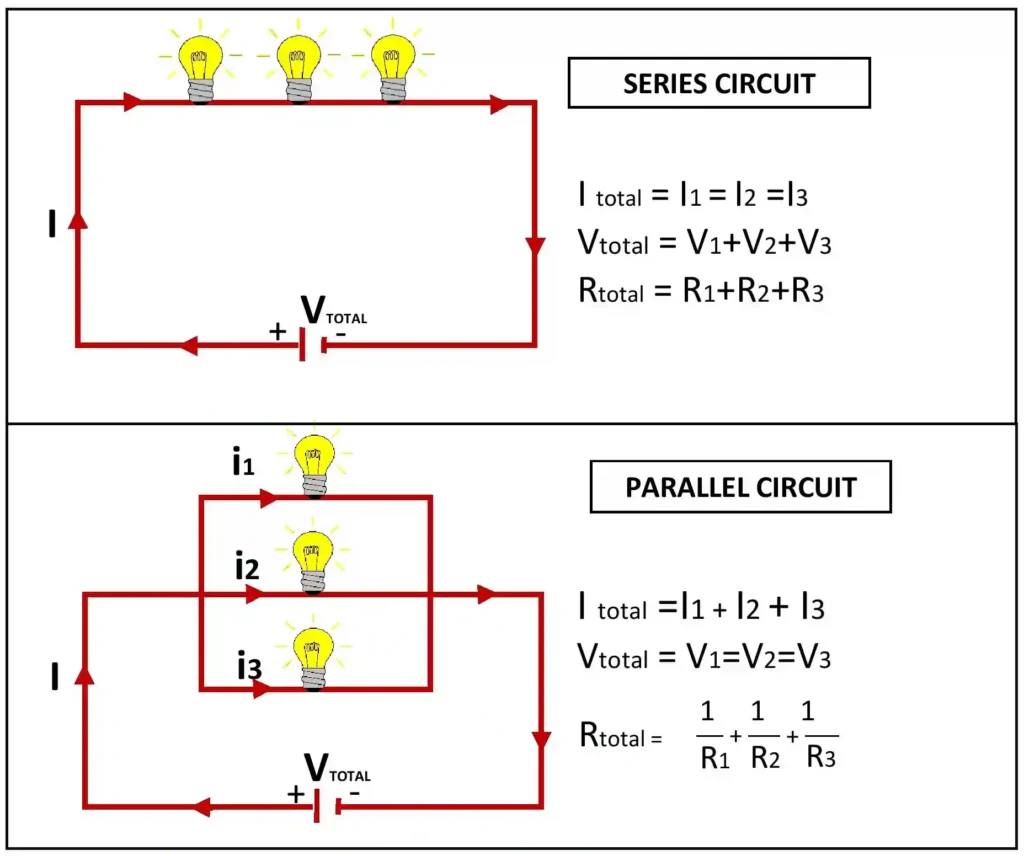
10. Series & Parallel Circuit Principle
Series Circuit
- Components are connected one after another.
- Current is the same through all components
- Voltage is divided among component
- Total resistance increases
- If one bulb fails, the entire circuit stops.
- Used where same current is required.
Parallel Circuit
- Components are connected in separate branches.
- Voltage is the same across each branch.
- Current divides into branches
- Total resistance decreases
- If one bulb fails, others still glow.
- Used in house wiring
11. Electromagnetic Effect of Current
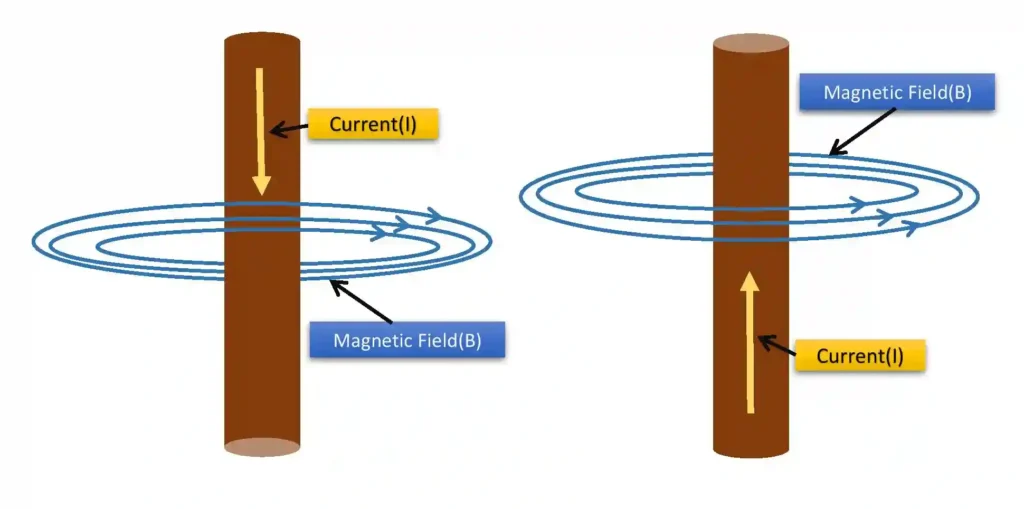
- it states that A current-carrying conductor produces a magnetic field around it.
- Current carrying conductors behave like magnets.
- fleming’s rules are applications of this law.
- a straight conductor produces concentric circular magnetic lines & a coil or solenoid produces magnetic field similiar to bar magnet.
- a current carrying conductor placed in an external magnetic field experiences a force.
- other applications : Electric motors , Relays & contactors , Electric bells
12. Faraday’s Law of Electromagnetic Induction
- it states that a changing magnetic field induces an electric current in a conductor.
- when the magnetic field around conductor changes, it produces an EMF which drives the electric current.
- This phenomenon is fundamental to the operation of generators, transformers, and various electrical devices in generation and transmission of electric power.
- faraday’s law explains the magnitude of induced EMF , while fleming’s right hand rule gives the direction.
- induced EMF (In volts) e = − n. dΦ / dt (n = no. of turns in the coil)
- − (negative sign) = direction of induced EMF (As per lenz’s law)
- Applications : Electric generators , Transformers , Induction cooktops
13. Lenz’s Law
- it states that Induced current always opposes the change in magnetic flux.
- Induced current reverses when direction of motion reverses.
- N-pole moving towards coil ⇒ flux increases ⇒ coil end becomes N ⇒ magnet is repelled.
- N-pole moving away from coil ⇒ flux decreases ⇒ coil end becomes S ⇒ magnet is attracted.
- Direction of induced EMF is given by e = − dΦ / dt.
- e = − dΦ = change in magnetic flux ,dt= change in time , (Φ =b A Cosθ, θ =Angle between magnetic field & area)
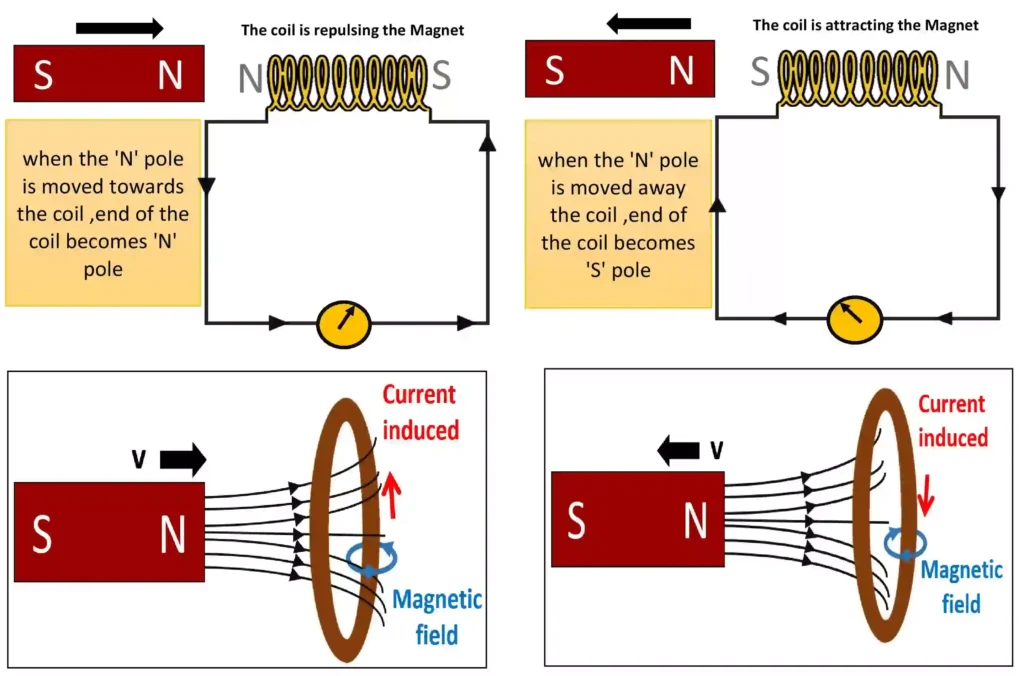
- this Law determines direction, not magnitude, of current.
- it Explains back EMF in motors and counter-torque in generators.
- Used in magnetic braking and eddy current damping.
- Based on conservation of energy.
- Applications : magnetic braking ,Eddy current Damping ,Transformer core heating reduction
14. Fleming’s Left & Right Hand Rule
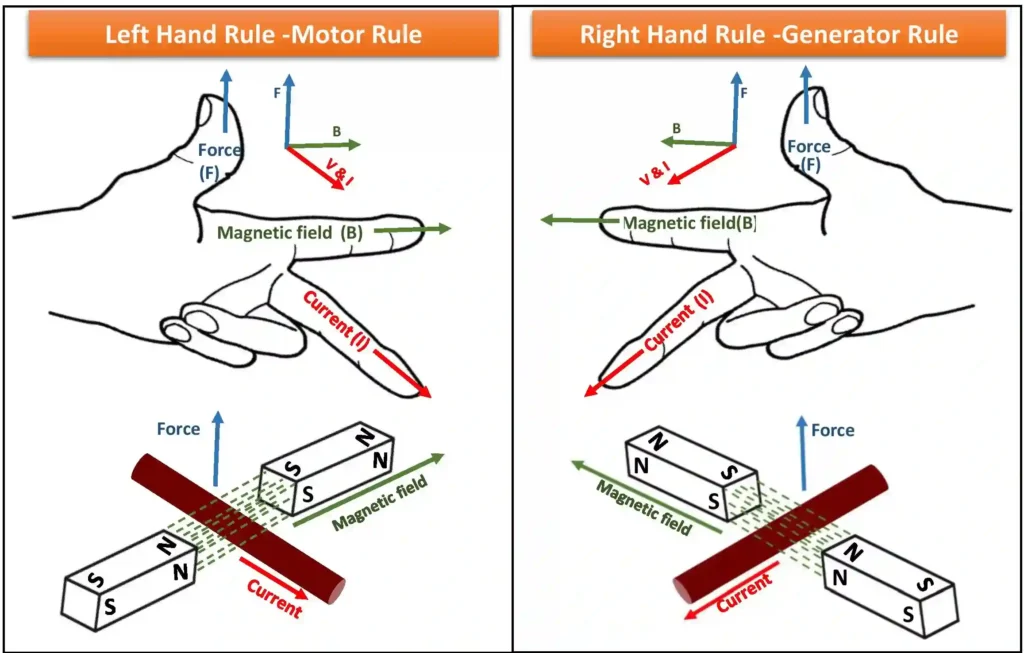
Fleming’s Left Hand Rule (Motor Rule)
- Fleming’s Left Hand Rule is used to find the direction of force (motion) on a current-carrying conductor placed in a magnetic field. its Used when current is known and Force/motion is required
- Works on motor principle
- Direction of current is conventional (+ to −)
- Force on conductor f = b i l sinθ
- f = force on conductor (N)
- b = magnetic flux density (in Tesla)
- i = current (Ampere)
- l = length of conductor (m)
- θ = angle between field and current
- Application: Electric motors ,Loudspeakers, Moving-coil instruments
Fleming’s Right Hand Rule (Generator Rule)
- Fleming’s Right Hand Rule is used to find the direction of induced current when a conductor moves in a magnetic field. its Used when motion is known and current is to be found
- Induced EMF: e=b l v sinθ
- E = induced EMF (Volts)
- B = magnetic flux density (In Tesla)
- L = length of conductor (m)
- V = velocity of motion (m/s)
- Works on electromagnetic induction & derived from Faraday’s law
- Application : Electric generators, Alternators, Dynamos
15. Inductance Principle
- Inductance opposes change in current.
- Variation in a current produces a changing , magnetic field, Which induces eMF in the same Conductor. The magnetic field change induces a second current in opposition to the original current – this is inductance.
- e = − L di/dt
- e = induced eMF , di/dt = rate of change of current , L = inductance (in henry)
- Current lags voltage by 90° in a purely inductive circuit.
- stores energy in a magnetic field.
- Applications : Chokes in tube lights , Motor starters
16. Capacitance Principle
- Capacitance stores electric charge when a voltage is applied across it.
- Charge stored in capacitor q =c V
- q=total charge in coulomb, c=capacitance in farad , v=voltage across plates
- voltage lags current by 90° in a purely capacitive circuit
- stores energy in electric field.
- Applications : Fan regulators , power factor correction , SMPS power supplies
17. AC RMS(root mean square) Value Principle
- aC constantly changes direction & magnitude. rMS value of aC is the equivalent dc value that delivers the same power to a resistive load.
- RMS value is the “effective” value of AC. It’s what matters for heating, lighting, or running devices.
- rMS is always positive even though AC goes positive or negative.
- calculation of RMS value :
- VRMS= VMAX /√2 , IRMS = IMAX /√2 (√2=1.414)
- VMAX & IMAX = maximum value( peak value) of voltage & current
- Power delivered to resistor P = I²RMS R = V²RMS /R
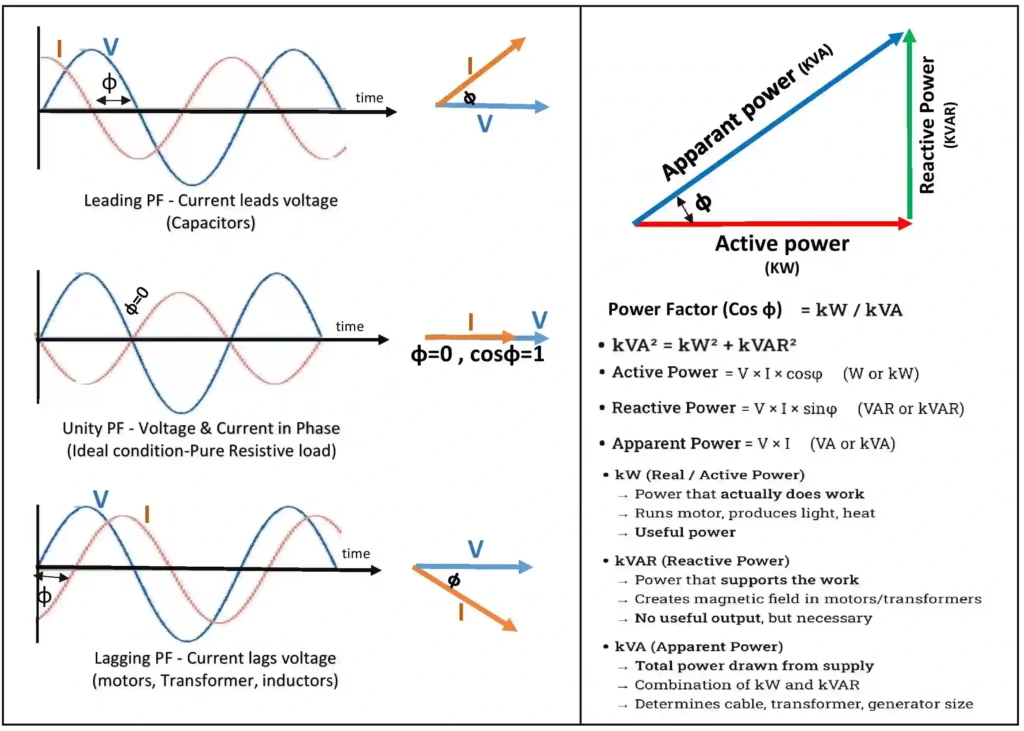
18. Power Factor Principle
- Power factor is the ratio of active power(kW) to apparent power(KVA).
- PF = Cosφ = kW/KVA Or W/VA
- Power factor represents how effectively electrical power is converted into useful work.
- Low power factor means higher losses(I²R losses), heating of cables & poor voltage regulation.
- Capacitors are used to improve power factor by compensating reactive power.
- Applications
- Industrial electricity bills
- Capacitor banks
- Energy efficiency improvement
19. Electrical Protection Principles
electrical protection ensures system reliability, it is needed to
- prevents overheating of wires & fire risk
- protect appliances of machines
- avoid electric shocks to human
Devices & Applications
1. Fuse
- Works on Joule’s heating effect
- Excess current melts fuse wire and circuit breaks
- Used in Plug tops , Old distribution boards , Electronic equipment.
- its for One-time use & gives Slow response for small overloads
2. MCB (Miniature Circuit Breaker)
- it works on dual protection principle
- Thermal effect provide overload protection & Magnetic effect short-circuit protection
- it Trips automatically and can be reset
- Used in House wiring , Lighting and socket circuits
- its Faster than fuse & Reusable
3. MCCB (Molded Case Circuit Breaker)
- it works on Thermal & Magnetic protection (high current range)
- it provides overload & short circuit protection.
- Used in Industrial panels , Heavy motors , Large loads
4. RCCB / ELCB (Residual -current /earth-leakage circuit breaker)
- Detects difference between phase and neutral current.
- ILeakage = IPhase − INeutral
- Trips when leakage exceeds safe limit (e.g., 30 milli-ampere)
- it provides Shock protection but not protect against overload or short circuit (used with MCB).
5. RCBO (Residual Current Breaking Overload)
- its a Combination of MCB & RCCB
- it protects against Overload , Short circuit , Earth leakage
- Used in Modern home distribution boards
6. Earthing (Grounding)
- Provides a low resistance path for fault current
- when Fault current flows to earth , protection device trips
- Used in Metal body appliances , Electrical panels
7. Surge Protection Device (SPD)
- Diverts high-voltage surges to earth
- used in Lightning protection , Sensitive electronics (TV, PLC, computers)
8. Thermal Overload Relay
- Heating due to excess current bends bimetal strip
- Used in Motor protection , Prevents motor winding damage
for Example If a geyser develops insulation failure:
- Leakage current flows to body
- RCCB detects imbalance
- Supply trips within milliseconds
- User is protected from shock
Load Estimation (Real Life Example)
Home Load Example
| Appliance | Qty | Voltage(V) | Current(i) | Power(V x a) | Total Power | Total current |
| Fan | 3 | 230 volt | 0.30 amp | =69W | 207W | 0.90A |
| LED Light | 5 | 230 volt | 0.04 amp | =9.2W | 460W | 0.20A |
| Refrigerator | 1 | 230 volt | 0.87 amp | =200W | 200W | 0.87A |
| geysor | 1 | 230volt | 8.70 amp | =2000W | 2000W | 8.70A |
| Total Load | 2867W=2.86kW |
Helps in MCB rating, cable size, and meter selection
Every electrical principle is directly connected to daily life. From switching on a bulb to running heavy machinery, the same electrical laws apply everywhere. Understanding them ensures:
- Safety
- Energy efficiency
- Correct appliance selection
- Long equipment life
read more about Electricity & its flow: simple explanation