
Concrete is the most widely used construction material in infrastructure, hydro projects, dams, industrial foundations, bridges, and buildings. Understanding its composition, strength behavior, grading system, batching calculations, and practical site knowledge is essential for engineers and construction professionals.
Concrete Composition and Hydration
Concrete is a composite material made of:
- Cement (binder)
- Fine aggregate (sand)
- Coarse aggregate (gravel or crushed stone)
- Water
- Admixtures (optional)
When water is added, cement undergoes a chemical reaction called hydration, forming Calcium Silicate Hydrate (C-S-H gel). This compound gives concrete its strength and durability.
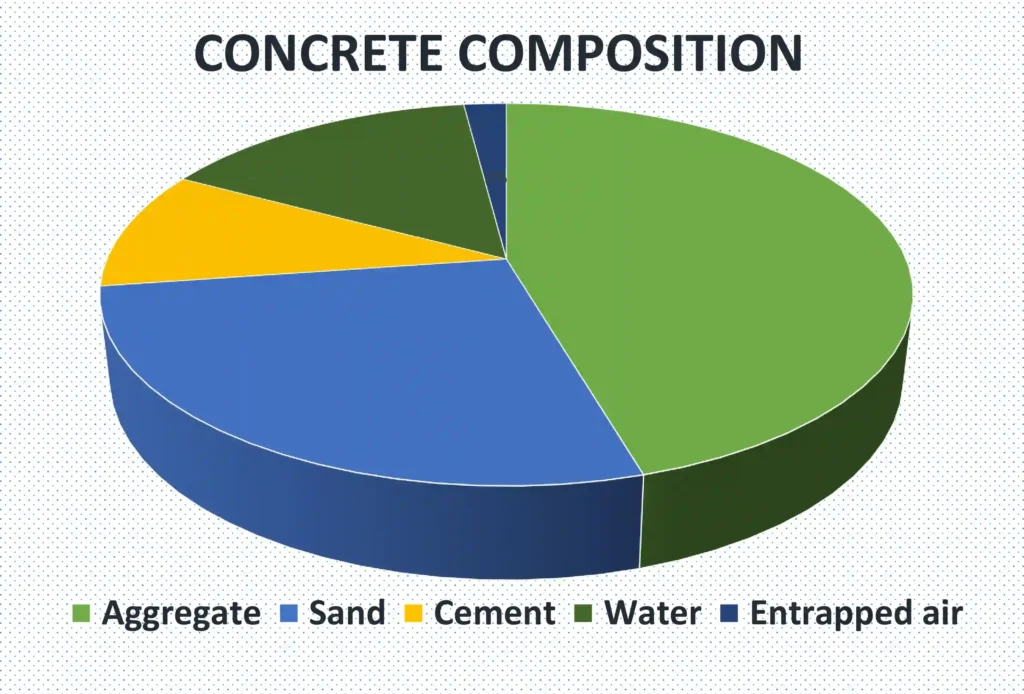
typical Composition (Approximate)
- coarse Aggregates: 40 –50%
- sand: 25–35%
- Cement: 10–15%
- Water: 15–20%
- Air entrapped: 1–3%
Aggregates form the bulk of concrete and directly influence strength and durability.
Concrete Grades & Strength
Concrete grades are expressed m15, M20, m25 etc ,where
- M = Mix
- 25 = 25 MPa compressive strength after 28 days
- 1MPa(Mega Pascal) = 1 N/mm²
Types of Strength in concrete
- Compressive Strength
- Ability of concrete to resist crushing or compressive loads.
- its Main strength (tested on 150mm cube using compression testing machine).
- Usually measured at 28 days curing age.
- Governs load-bearing capacity of columns, footings, and foundations.
- Tensile Strength
- Ability of concrete to resist pulling or stretching forces.
- Approximately 8–12% of compressive strength.
- Determines crack resistance and durability.
- Measured using split tensile test.
- Low tensile strength is the reason steel reinforcement is required in RCC.
- Flexural Strength
- Ability of concrete to resist bending stresses. Also called Modulus of Rupture.
- Important for beams, slabs, pavements, and floors.
- Tested on concrete beam specimen under loading.
- Represents combined action of compression and tension.
- Shear Strength
- Resistance of concrete against sliding failure along a plane.
- Important in beams, columns and footings.
- Mainly supported by reinforcement in RCC.
- Bond Strength
- Strength between concrete and steel reinforcement.
- Ensures proper load transfer between steel and concrete.
- Affected by surface condition of bars and compaction.
- Impact Strength
- Ability to resist sudden or dynamic loads.
- Important for industrial floors, pavements, and machine foundations.
- Fatigue Strength
- Resistance under repeated loading cycles.
- Important in bridges, highways, and rotating machine foundations.
- Modulus of Elasticity
- Indicates stiffness of concrete.
- Higher modulus = less deformation under load.
Mix Ratio, Water-Cement Ratio & Volume-Weight Relationship
Nominal Mix (Small Works)
Example: for M20 grade → cement: sand: aggregate =1 : 1.5 : 3
Above M20, design mix is used based on laboratory calculation.
Water-Cement Ratio (W/C)
- W/C Ratio = Weight of Water ÷ Weight of Cement =0.35 – 0.55
- Higher W/C → Cracks, bleeding, low durability
- Lower W/C → Higher strength
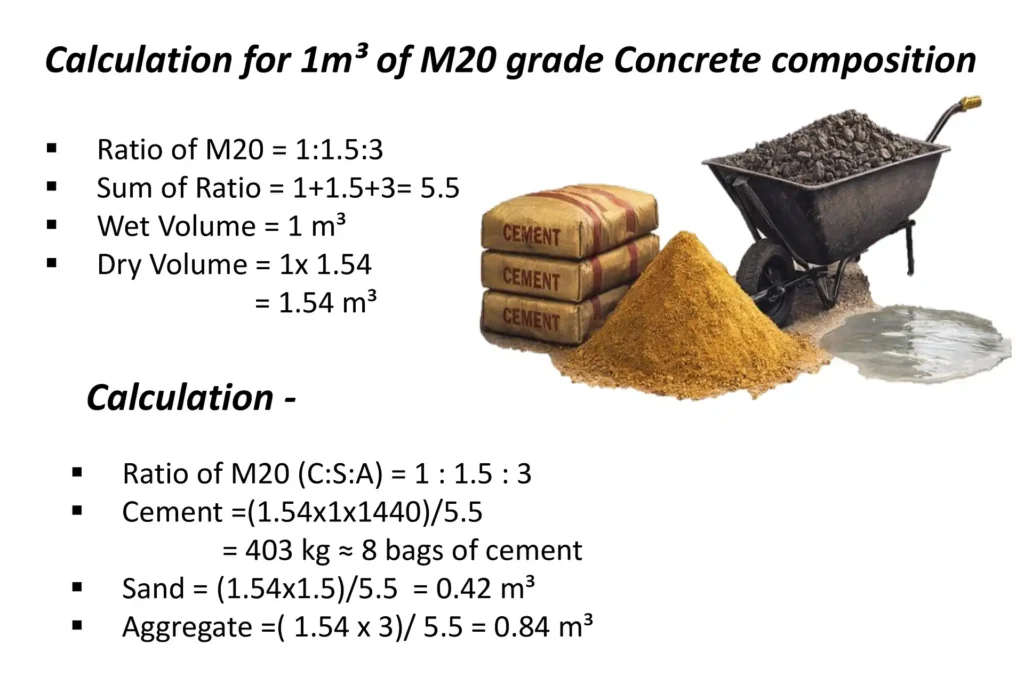
concrete Dry Volume vs concrete Wet Volume
- Dry Volume = 1.54 × Wet Volume
Density and Weight Relation
- Density of fresh concrete ≈ 2400 kg/m³
- So, 1 cubic meter (1m³) concrete ≈ 2400 kg total weight
- Concrete is ordered in volume (m³) but batching plant measures materials in kilograms.
Concrete Grades with Nominal Mix Ratios
| Grade | mix Ratio (C:S:A) | Strength (MPa) | Aggregate size | Common Use |
| M5 | 1 : 5 : 10 | 5 MPa | 40mm | Levelling course |
| M7.5 | 1 : 4 : 8 | 7.5 MPa | 40mm | Non-structural work |
| M10 | 1 : 3 : 6 | 10 MPa | 40mm | PCC, flooring base |
| M15 | 1 : 2 : 4 | 15 MPa | 20mm | Pathways, small foundations |
| M20 | 1 : 1.5 : 3 | 20 MPa | 20mm | Slabs, residential beams |
Design Mix Concrete (Used in Industrial & Hydro Projects)
For grades above M20, ratios are NOT fixed
| Grade | Strength (in MPa) | Aggregate size | Typical Use |
| M25 | 25 MPa | 20mm | Columns, RCC beams |
| M30 | 30 MPa | 20mm | Industrial slabs |
| M35 | 35 MPa | 20mm/12.5mm | Heavy structures |
| M40 | 40 MPa | 20mm/12.5mm | Bridges |
| M45 | 45 MPa | 12.5mm | Water retaining structures |
| M50 | 50 MPa | 12.5mm | High-rise & infrastructure |
| M60+ | 60+ MPa | 10mm-12.5mm | Special high strength concrete |
For these grades, mix design is done as per:
Batching Plant & Practical Industrial Information
Types of Batching
- Volume batching (small sites)
- Weight batching (industrial projects – recommended)
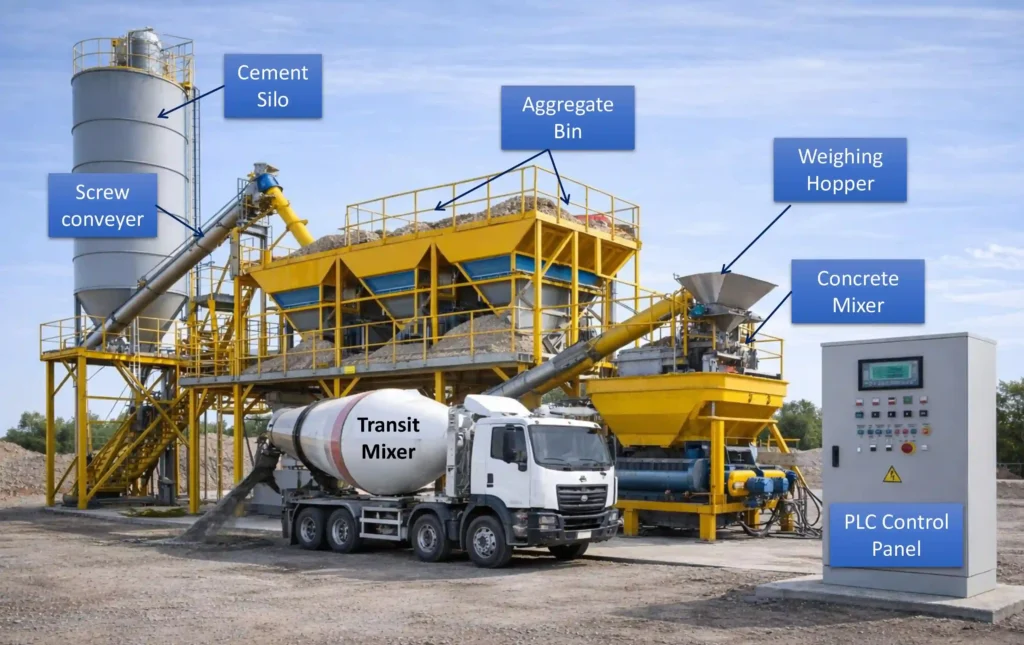
Main Components of a Batching Plant
- Cement Silo
- Screw Conveyor
- Aggregate Bins
- Load Cells (weight sensors)
- Weighing Hopper
- Mixer (Pan Mixer / Twin Shaft mixer)
- PLC (Programmable Logic Controller) panel
Approximate Material for 1 m³ M20 Concrete
- Cement: 300–350 kg
- Sand: 650–700 kg
- Aggregate: 1100–1200 kg
- Water: 150–180 liters
(Actual values depend on mix design)
Important Site Checks
✔ Load cell calibration
✔ Moisture correction in sand
✔ Slump test before pouring
✔ Proper vibration
✔ No extra water addition
Workability, Slump Test & Curing
Workability : Workability is the ease of mixing, placing, and compacting concrete.its Measured using Slump Test.
| Slump (mm) | Workability |
| 25–50 | Low |
| 75–100 | Medium |
| 100–150 | High |
- Too high slump = Excess water
- Too low slump = Difficult compaction
Curing of Concrete
Curing maintains moisture for hydration. Minimum curing:
- OPC → 7 days
- PPC/PSC → 10 – 14 days
Concrete achieves:
- ~70% strength in 7 days
- 100% design strength in 28 days
Improper curing causes cracks and low durability.
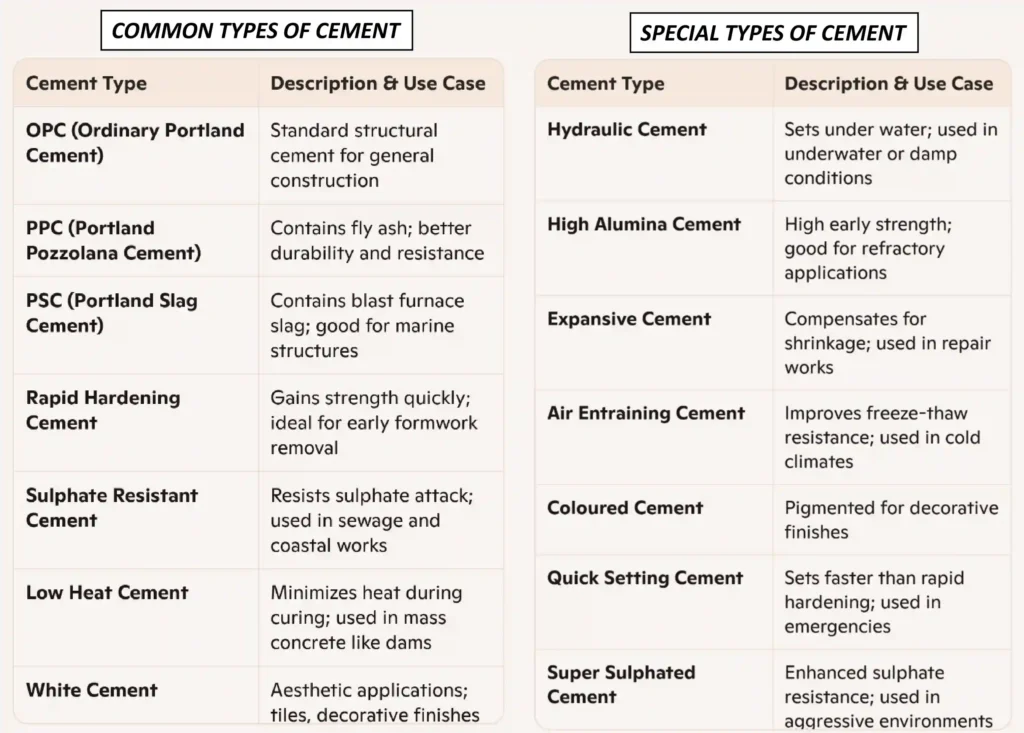
Types of Cement Used in Industries
- Ordinary Portland Cement (OPC) : Grades: 33, 43, 53 .Used in general structural work.
- example: grade 33 indicate Cement Strength 43 N/mm² or mpa
- Portland Pozzolana Cement (PPC) : Contains fly ash. Better durability and lower heat.
- Portland Slag Cement (PSC) : Used in marine and sewage structures.
- Rapid Hardening Cement : Used for road repair.
- Sulphate Resistant Cement : Used in coastal and sewage areas.
- Low Heat Cement : Used in dams and mass concreting.
Other Basic Materials Used with Concrete
- Reinforcement Materials – Provides tensile strength and crack resistance in RCC.
- Steel (TMT – Thermo-Mechanically Treated Bars)
- Aggregates – Fills voids and improves workability.
- Coarse Aggregates (Proper Grade/Size Required)
- Provide bulk volume and compressive strength.
- Fine Aggregate / Sand (Silt Content < 8%)
- Mixing Water – for cement hydration and strength development. it significantly affects durability.
- Potable Water
- Chemical Admixtures – Used to modify workability, setting time, and strength properties.
- Plasticizers
- Superplasticizers
- Retarders
- Accelerators
- Supplementary Cementitious Materials (SCM) – Improve durability, reduce permeability, and enhance long-term strength.
- Fly Ash
- GGBS (Ground Granulated Blast Furnace Slag)
- Silica Fume
- Metakaolin
- Fiber Reinforcement Materials – Used for crack control and impact resistance.
- Steel Fibers
- Polypropylene Fibers
- Glass Fibers
- Basalt Fibers
- Mineral Fillers – Improve particle packing and reduce voids.
- Limestone Powder
- Quarry Dust
- Curing Materials – Ensure proper hydration
- Water curing systems
- Curing compounds
- Wet burlap / hessian cloth
- Formwork Materials – Provide shape and support to fresh concrete.
- Steel shuttering
- Plywood formwork
- Aluminum form systems
Concrete in Hydro & Industrial Infrastructure
Concrete is used in:
- Dams
- Spillways
- Pump houses
- Retaining walls
- Canals
- Machine foundations
- Industrial floors
Such structures require:
- Proper reinforcement cover
- High durability
- Controlled heat of hydration
- Low permeability

Important Abbreviations
- PCC – Plain Cement Concrete
- RCC – Reinforced Cement Concrete
- RMC – Ready Mix Concrete
- OPC – Ordinary Portland Cement
- PPC – Portland Pozzolana Cement
- PSC – Portland Slag Cement
- W/C – Water-Cement Ratio
- fck – Characteristic Compressive Strength
- w/b – Water-Binder Ratio
- FA – Fine Aggregate
- CA – Coarse Aggregate
- GGBS – Ground Granulated Blast Furnace Slag
- SF – Silica Fume
- FAsh – Fly Ash
- NDT – Non-Destructive Testing
- UPV – Ultrasonic Pulse Velocity
- RCPT – Rapid Chloride Penetration Test
- SD – Standard Deviation (used in mix design)
- TMT – Thermo-Mechanically Treated Steel
- CLR – Cover to Reinforcement
- L/D – Length to Diameter Ratio (specimens)
Final Summary
Concrete is not just a mixture of cement and sand. It is a scientifically designed material where:
- Grade defines strength in MPa (=N/mm²)
- Water-cement ratio controls durability
- Concrete density ≈ 2400 kg/m³
- Dry volume = 1.54 × Wet volume
- Weight batching ensures accuracy
- Grade number = MPa strength after 28 days
- Dry volume = 1.54 × Wet volume
- Lower W/C ratio = Higher strength
- Weight batching preferred in industries
- Proper curing ensures durability
- Concrete is strong in compression but weak in tension (≈8–12%).
Read about Pre-Engineered Building (PEB) Components